Thursday, January 8, 2009

Virtual Reality work in progress

In 1999, the Hill and Knowlton PR firm unveiled their newest project, The Virtual Crisis, which was to simulate a crisis on an interactive CD-ROM. The 6-hour simulation needed two specifically trained H&K facilitators that worked with about 20 corporate team players. Along with supplying the gamers with a virtual situation, it provided them with a comprehensive oral critique of the participants’ decisions and responses. The “game” cost $10,000 and it was used mainly by top executives that when called upon, would be able to act and communicate the right response during a crisis situation.
The Virtual Crisis was developed by H&K managing director Richard Hyde, and allowed for participants to learn specific strategies that would allow them to ward off the media while concurrently coping with an entire set of other distractions.
Pretty amazing.
I’ve also read that Kamer-Singer & Associates used the 1989 Exxon Valdez oil spill as their mockup crisis situation. The staff and employees of the company’s internal PR group played the role of environmental activists, politicians, aggrieved residents, and skeptical reporters.
Apparently this virtual simulation helps PR people to deal with high stress situations and high emotions that can exasperate the original problem. It allows for practice because real crisis' are highly risky. Apparently the program makes several different scripts in which the conclusion always minimizes the corporate culpability.
Obviously.
Another interesting point, I was looking up the oil spill on Wikipedia, and one of the last lines of the article states “WikiScanner discovered changes made from within Exxon Mobil altering this article's descriptions of the oil spill and downplaying its severity.”
I wonder which department tamperd with the facts.. 

In the words of Albert Einstein, "A clever person solves the problem, a wise person avoids it." 

I think throughout my blogging, I may have come across quite harshly towards the PR industry, but I believe its because I'm trying to understand the business. I am trying to see both sides of the story, and throughout my research I have discovered good and bad PR. In all, I have understood that there are experts who are working for the corporate interest, and there are experts and non-experts who are working for the public interest. I have learned that we may never know the truth, and that the truth will come in many forms. The only way to really ever be satisfied with anything you read is by questioning the information that is given to you. 


References:

Wikipedia :Exxon Valdez Oil Spill". www.wikipedia.org


Wednesday, January 7, 2009

Psychoanalytical Spin Man

I'm reading this book called "Trust Us, We're the Experts!" by Sheldon Rampton and John Stauber, which is a book that in my opinion, fears the Public Relations industry. The authors seem to say that the masses are unthinking and incapable of forming their own opinions without the help of an outside and obviously powerful source. Although I am quite skeptical of all of this, because I am part of this "masses" they speak of, and because I consider myself a free-thinking individual capable of thinking for myself, and I am studying PR, I did come across a quote from the Father of Public Relations, Edward Bernays:

"The conscious and intelligent manipulation of the organized habits and opinions of the masses is an important element of democratic society." He goes on to say that this manipulative mechanism of society becomes our ruling invisible government in which our "minds are molded, our tastes formed, our ideas suggested, largely by men we never heard of." Lastly he says, "it is they (the relatively small number of persons) who pull the wires that control the public mind." (42)

Scary thought, don't you think?
Bernays used psychological techniques to mask the motives of his clients to deliberately keep the public "unconscious" of the forces that were working to mold their minds (42). 

And there you have it, the Father of Spin. He may have just proved that "truth" in the media is tampered with, but we still, as this unintelligent masses, cannot know which facts are changed. This is in part because we are not part of the "intelligent few", the group of people Bernays felt controlled public thought. However, Bernays seems to say that controlling public thought isn't so bad because PR is an applied science in which society's leaders can bring order out of chaos (44). 

PR and the media is working against us. If you are an intelligent intellectual individual, is it possible to rise above and find the truth. I suspect the only way of uncovering the truth is to actually be present when the "truth" happens.

Reference:

Rampton, Sheldon and John Stauber. Trust Us, We're the Experts!. Penguin Putman Inc., New York: 2001.

Some truth....

I have been trying to understand how and why PR practitioners and the media in general feel the need to "spin" their stories, or hide the truth. As we have discovered in my previous post, the truth can be ugly and scary, and well lying is easier then explaining the real facts. No one who smokes really wants to know that their favorite product is killing them softly.
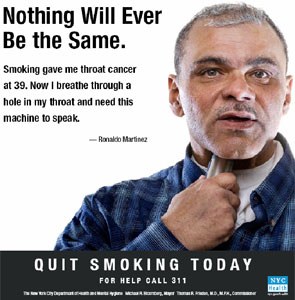
I remembered a very intelligent campaign that appeared at the beginning of this decade called "Protect the Truth". It was one of the largest youth-focused anti-tobacco educational campaigns that exposed the Big Tobacco industries marketing practices. It is no longer legal for tobacco companies to advertise their products, so tobacco sales relied heavily on the addiction of their product, peer pressure and alcohol. The promoting of tobacco products by a PR person was a serious faux-pas, so the "non-intelligent masses" began to use their brains and subsequently came up with an anti-smoking PR campaign. 
This PR campaign was designed to show the whole truth about smoking. They used the real facts and real testimonials to get their message across. According to their website www.protectthetruth.org, their campaign was successful. Although the statistics do not calculate how many youths actually stopped smoking, they do state that the Truth campaign was remembered and that some youths now understood the dangers of smoking. The campaign was not designed to get youths to stop smoking, but to raise awareness of the harmful effects of smoking.
Finally a PR campaign that doesn't tell lies or "spin" stories!  Although, promoting an anti-something campaign is easier then trying to promote a difficult subject like war.. 
Don't be mistaken, war has been promoted, but the ugly truth and death is never mentioned.


value="true">

The tobacco companies PR practitioners busy at work re-wording their intentions. A very smart "spin" tactic indeed!

Monday, January 5, 2009

Smoking is Good for you!


One of Edward Bernays earliest clients was the tobacco industry. This industry relied heavily on experts to help them sell their products, as well as "gifted" individuals like opera singers, sports players and doctors who could claim that smoking never hurt them. 
Back in the day, this was probably easy because the negative effects of smoking was rarely known and PR practitioners could say just about anything, and the public would believe them. Doctors actually agreed to say that smoking was good for you! Although, now we know that these "doctors" were just paid actors in doctor uniforms. 


Here is some truth.


Sunday, January 4, 2009

To re-brand oneself

As I am again eluding to the same book I have just finished over Christmas, How to Lose Friends and Alienate People, Toby Young discusses to idea of re-branding himself. Being the young Brit he is in his new city of New York, a city obsessed with appearance and money, Young hires a focus group to take a look at his life, and change it. 
He possesses none of the traits needed to survive in NYC. He is bald, ugly, has bad teeth, and isn't rich.
What the focus group does is pull together 5 of Toby's top female friends and have them talk about him while he sits behind a double-sided mirror. In the end the only thing that is concluded is that Toby Young has unfortunate misadventure of being born, and he will have a lot of trouble getting a girl in this city.
I understand the concept of rebranding yourself in order to give yourself a more charming appearance to the media, but I have just come across the idea of countries rebranding themselves!
They do this in order to rid themselves of older cliches or stereotypes, and in effect are trying to re-sell themselves as a new and improved society.
Apparently Estonia tried to rename its country to e-stonia, as in e-business, to establish themselves as a country headed for the digital future... this didn't pass over well.
Again, I am trying to find out the truth, and again I am pointed in the direction of PR reshaping an idea, and in this case a country. 
According to the article I read, Germany was trying to rebrand itself back in 2003. What I found particularly interesting was that their PR people were well aware of the stereotypes of Germany, and instead of trying to get the public to forget this, they just worked on placing new ideas about Germany. The unfortunate truth about stereotypes is that they stick, and with Germany, they will probably stick forever.
So the German PR people set about creating a campaign that would make Germany into a "sexy" country, full of Love Parades and all-night techno beach parties. 
Perception is a huge issue and it is the center of a PR campaign. Although Germany thought their campaign would wash over well in most European countries, they felt the Brits were the most difficult to persuade that they were no longer the people associated with post-war Germany. According to this article, Britain aired too many documentaries about the destruction of the Nazis and the horrors of the Holocaust to do any good for their country. 
Sex sells once again in my opinion. German PR agents faced with a country with a horrible history will have to use sex to sell their country. Now will we think the Germans to be a free-spirited flower-child society full of dance parties? Who knows, as with celebrity PR, the bigger the party animal, the more papers will sell.

References:

Murphy, Claire. "Making Germany Sexy". BBC News Online. 8 July 2003. 4 Jan 2008. http://news.bbc.co.uk/2/hi/europe//3055254.stm

Friday, January 2, 2009

This is what happens... when you fire your publicist

Although this is an image of Britney with still the presence of a publicist, you can bet they had no control over the distribution of this picture. Since then, Britney has fired all her publicists and has stated that she will be handling her own PR from now on. She fired Leslie Sloane-Zelnick in an effort to introduce her second child to the world, perhaps thinking her own way of doing business would be better handled then a professional. I beg to differ. As we have seen, Britney is a train-wreck and without the help of someone, she is destined to fail. 

I would like to comment that I do understand the rage that is forcing Britney to take such drastic decisions for her life, because as we have discovered, ever since a very early age, Britney had no control over any part of it. 
PR people, fashion stylists,managers, producers, the list goes on, have always told her how to look, dress, act, and eat. Its no wonder the girl is going completely crazy!  But firing her Publicist, could this be a good move?
As her story unfolded, she barley held her head over the water as she paddled from scandal to scandal, and without the help of a proper publicist, she is headed for the undertow.
She then appeared on NBC's Dateline and was interviewed by Matt Laurer. She showed up chewing gum, in a "painted" on outfit, ill-fitted for her size, and apparently had done her own hair and make-up, quite obvious. 
With regards to "truth" in the media, perhaps Britney has finally done it. She bares all, and gives the public the "real" Britney. Bad hair extensions and a cellulite-riddled behind. 
With no presence of a PR person to "spin" her stories, perhaps we can look to the journalist who may be the reason why there is so much "Britney bashing" in the media. Can we speculate that it is not the PR people who paint a pretty picture of their clients, but the newspapers who create an ugly one?


Thursday, January 1, 2009

The Publicist Bouncer

In the world of a celebrity today, you are nothing without a Publicist. If I may go further then this, you are nothing, especially not an A-list star, without the help of famous celebrity Publicist, Pat Kingsley.
Back in the day, celebrities were owned by the studios they worked for. In order to appear on magazine covers, they had to follow strict rules from their studios who would be able to sell their clients by covering up their scandals. They were owned, and consequently everything was covered up, the stories that couldn't be hushed up were re-written with happier endings.
All this changed when Pat Kingsley rose from the depths and would change the world of celebrity coverage forever.

By the early 1970's, the studio-system was over, and stars were free to sell their stories to whichever magazine they wanted. When this seemed too difficult for the stars to handle, they began to hire Publicists, people who could answer phone-calls and arrange for photo shoots. Then along came Pat Kingsley who would re-write all the rules.
Suddenly, it wasn't the paper that had all the rights, but the publicist. Pat Kingsley would be known as the "no woman". Saying no to everything until she got her way. Journalists and interviewers had to submit a list of potential questions before an interview for approval, and if Kingsley did not like the questions the whole interview could be pulled. She once was quoted saying to one editor, "why do you get to choose who goes on your cover?" (The Observer). Talk about ultimate media control! She controls or prohibits every single piece of information about her A-list clients, and she owns all of them. The celebrities have no problem with this, because they are protected from media scrutiny.

When Calista Flockhart was to appear on the Today's Show, Kingsley got wind that the producers would interrogate her client about her weight loss, and cancelled her interview. Pat Kingsley is known and feared. She is not the person you want to anger, because by doing so, she just may blacklist you from her entire list of extremely famous clients.
Yet, it seems that this "tight-lipped" way of doing business may be losing its charm today.
There are now magazines like In-Touch and Star, all tabloids, that use pictures of celebrities to sell their magazines. They cannot and do not rely on a publicist in order to tell their stories, but make them up as they see fit. They indulge the reader in all sorts of ridiculously factitious stories, and it works! The public eats them up and believes them! Actually, stars like Britney Spears and Colin Farrell probably have these magazines to thank for their never ending popularity. By seeing your favorite celebrities stumbling out of clubs or wearing no underwear may be perceived to the reader as the "truth". There is no one covering up this story, just the raw and in some cases "bare" reality.
To these bright new faces or plummeting stars of Hollywood, it is the tabloids and not the Publicist who will make their name today. Their actual careers come in close second to the business of managing the public perception of their careers.

As Oscar Wilde said once: "They've put their talent in their work, but their genius in their press coverage".


Reference:

Sternbergh, Adam. "Cruise Control: The Publicist Behind the Movie Star". Slate. 5 April 2004. 1 Jan 2009  http://slate.com/id/2098277